
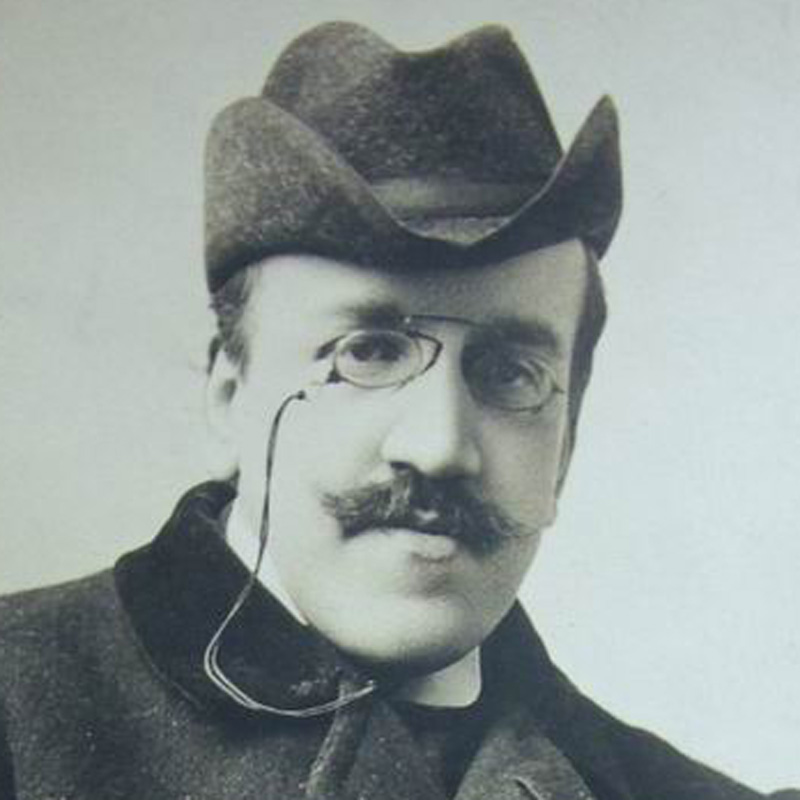
Vladimir Rebikov
Did you know?
From 1901 to 1904, Vladimir Rebikov ran the first composer controlled record label, issuing primitive phonograph records of singers from the Moscow Opera performing his own works and those of others.
Vladimir Rebikov is a founding figure among modern Russian musicians and a pioneer in the use of the whole-tone scale. He studied piano with his mother, and completed a course in linguistics before entering the Moscow Conservatory; there he studied music theory with Nikolai Klenovsky, a student of Tchaikovsky. Throughout his career, Rebikov would expand his harmonic palette to include seventh and ninth chords, unresolved cadences, polytonality, and harmony based upon open fourths and fifths. Yet Rebikov never strayed from within the boundaries of tonality and did not seek to experiment with atonality. Rebikov's new style did win some recognition, including a vote of confidence from Grieg, although most of this encouragement came from outside Russia, where Rebikov's work was received with confusion and contempt. Rebikov settled in Yalta in 1909, and in his last years attempted to expand his dramatic concepts out of the melomimic miniatures and into something more substantive. His final theatrical work, Dvorianskoe gnezdo, Op. 55 (The Nobleman's Nest, 1916), is a hyper-realistic setting of a Turgenev play where the vocal parts are speech-based and the music a mere underpinning to support the action. Characters break into song only as relevant to the story, as in the manner of a movie musical. Every aspect of the production, including psychological profiling of characters and set design, is contained in the score. The Nobleman's Nest was a brave experiment, but a failed one, as Rebikov fashions the music so scantily that it is unable to stand on its own merits. Rebikov was already a forgotten figure by the time of his death at age 54. He was bitter and disillusioned, convinced wrongly that composers such as Debussy, Scriabin, and Stravinsky had made their way into public prominence through stealing his ideas. Ironically Rebikov is best known by way of his insubstantial music in salon genres. Rebikov's role as an important early instigator of twentieth-century techniques deserves to be more widely recognized.
