
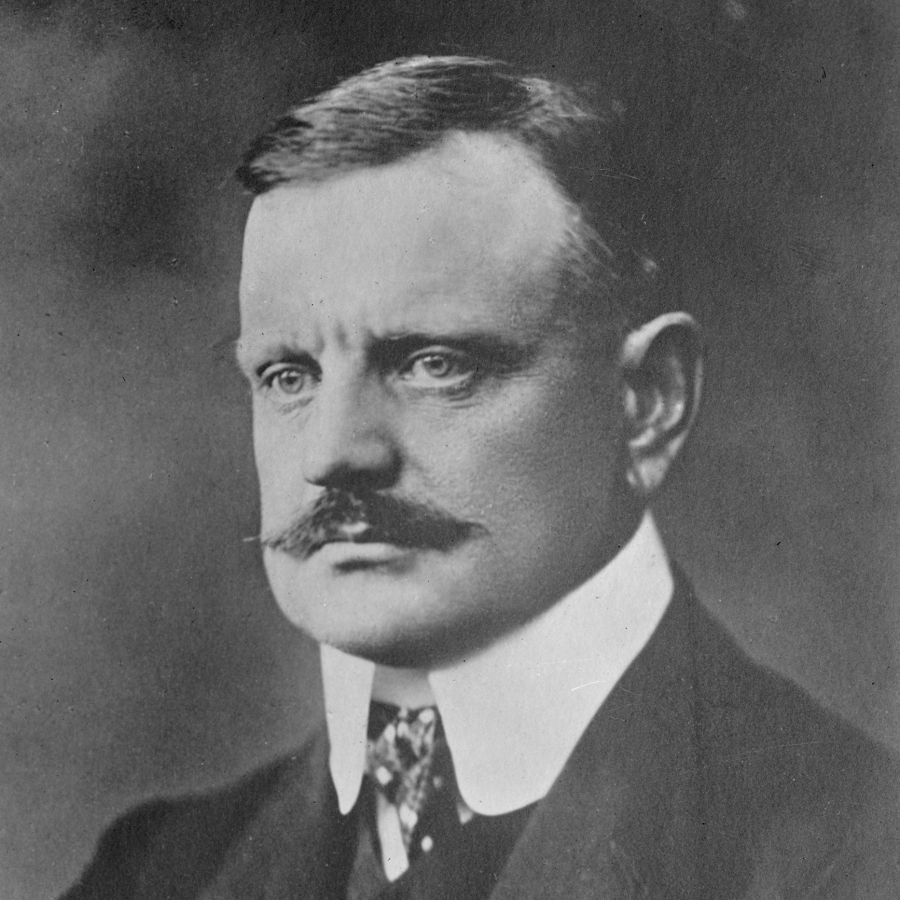
Jean Sibelius
Did you know?
Sibelius himself once said about his critics, “Pay no attention to what critics say. No Statue has ever been put up to a critic".
Jean Sibelius was born in Hameenlinna, Grand Duchy of Finland on December 8, 1865. Early records indicate that Sibelius started getting serious about his musical education around the age of fourteen. At the age of twenty, he decided to embark upon a career in music. He enrolled in the Helsinki Music Academy in 1885 and he continued his studies there till 1889; interestingly, the school has now been renamed to the Sibelius Academy in his honor. Sibelius then studied composition with Martin Wegelius, Albert Becker and Karl Goldmark. He initially wanted to be a violin virtuoso, but he had to abandon his dreams upon realizing that he started his violin training much too late in his career. Between 1889 and 1891, Sibelius studied and composed in Berlin and Vienna. He also spent a year in Italy between 1900 and 1901. Sibelius is most known for his seven symphonies. They were known for their adventurous use of chord patterns and tritones. Sibelius’s symphonies also implicated complicated melodic structures. The uses of the Dorian Mode and Polyphony in his works are generally cited. Even though Sibelius was not a violin virtuoso, he wrote a great deal of magnificent works for the instrument. His Violin Concerto in D Minor of 1904 was of primary importance. The three movement piece is widely considered to be one of the most technical and formidable concerto works for the violin. The third movement in particular, has been described as a “polonaise for polar bears”. Much of Sibelius’s work received bad reviews from critics, who termed the composer’s works ‘weak’ and ‘weird’. However, Sibelius’s works stood the test of time and they were often the popular choice in both concert halls and orchestras. Sibelius himself once said about his critics, “Pay no attention to what critics say. No Statue has ever been put up to a critic”. Interestingly, the Sibelius Monument was erected in 1967, ten years after his death. Sibelius had multiple health problems during his life. In 1907, he underwent surgical treatment for throat cancer. Jean Sibelius died in Ainola, Finland, on September 20, 1957 due to a brain hemorrhage.
