
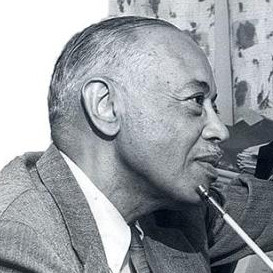
William Grant Still
Did you know?
He was the first African-American composer to have a symphony performed by a professional orchestra in the U.S.
Known as the "Dean of African-American Composers," William Grant Still was born in Woodville, Mississippi and raised in Little Rock, Arkansas, where his mother was a high school English teacher. He began to study the violin at age 14 and taught himself to play a number of other instruments, excelling at the cello and oboe. In 1911, Still entered Wilberforce University in Ohio where he gained valuable experience conducting the University band and producing his first attempts at composition and orchestration. Although his abilities as a performer and arranger led to many opportunities for him beyond the concert hall, he was inspired by the career of Samuel Coleridge-Taylor to become a composer of concert music and opera. William Grant Still's career was comprised of many "firsts". He was the first African-American composer to have a symphony performed by a professional orchestra in the U.S., the Symphony no. 1 "Afro-American" (1930). It was premiered by Howard Hanson and the Rochester Philharmonic. The piece's New York premiere was given by the New York Philharmonic at Carnegie Hall in 1935. He also became the first African-American to conduct a major symphony orchestra in the United States when he led the Los Angeles Philharmonic in 1936. In the world of opera, his Troubled Island was the first by an African-American to be performed by a major opera company (New York City Opera, 1949) and that same opera was the first by an African-American to be nationally televised. Although William Grant Still did not write a large quantity of works for solo voice and piano, the quality is very high. Still set many of the great poets of the Harlem Renaissance including Paul Laurence Dunbar, Langston Hughes and Countee Cullen. He also set poetry by his second wife, Verna Arvey, an accomplished writer and pianist who wrote the libretti for most of Still's operas. Perhaps his most ambitious work for voice and piano is the song cycle "Songs of Separation" which sets poetry by Dunbar, Hughes, Arna Bontemps and Haitian poet Philipps Thoby-Marcelin (in French). In the cycle, Still sets five poems of diverse authorship with a common literary theme and constructs a unified musical framework around the poems. As in his famous Symphony no. 1, Still utilizes the harmonic and rhythmic language of jazz and blues to portray the sense of "otherness" inherent in the poetry.
