
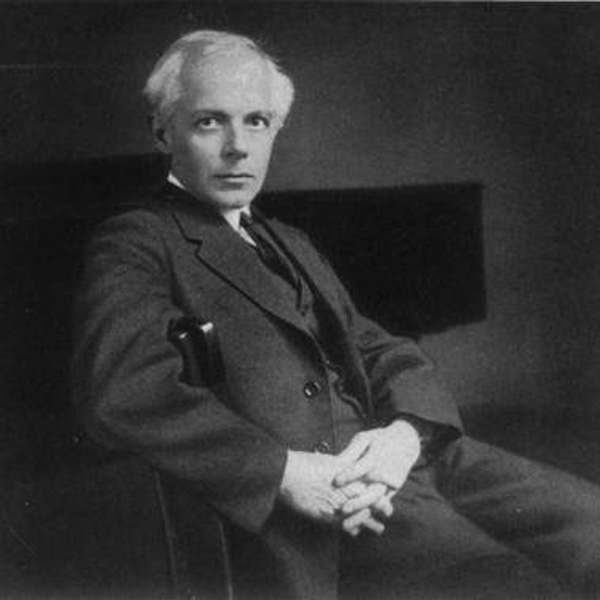
Béla Bartók
Did you know?
Bartók would go into Hungarian, Transylvanian and Romanian villages with this bulky recording device and ask the local peasants and farmers to sing or play the songs that they knew.
Hungarian composer, pianist, and ethnomusicologist, Bartók is considered one of the most important musical figures of the 20th century. He and Liszt are regarded as Hungary's greatest composers. Through his collection and analytical study of folk music, he was one of the founders of comparative musicology, which later became ethnomusicology. Bartók was born in Hungary (modern-day Romania) on 25 March 1881 and received his first instruction in music from his mother, a very capable pianist. After his family moved to Bratislava in Slovakia, he took lessons from László Erkel, and in 1899 he became a student at the Royal Academy of Music in Budapest, graduating in 1903. Bartók, who had given his first public concert at the age of eleven, now began to establish a reputation as a fine pianist that spread well beyond Hungary’s borders, and he was soon drawn into teaching. His earliest compositions offer a blend of late Romanticism and nationalist elements, formed under the influences of Wagner, Brahms, Liszt, and Strauss. Around 1905 his friend and fellow-composer Zoltán Kodály directed his attention to Hungarian folk music which together with the music of Debussy, changed Bartók’s musical language. As he absorbed more and more of the spirit of Hungarian folk songs and dances, his own music grew tighter, more concentrated, chromatic and dissonant. Although a sense of key is sometimes lost in individual passages, Bartók never embraced atonality as a compositional technique. Bartók was an assiduous ethnomusicologist, in 1906 he published a volume of the songs he had collected in his trips around Hungary, Transylvania, Romania, North Africa, and more. In the 1920s and ’30s, Bartók’s international fame spread, and he toured widely, both as a pianist and as a respected composer. He continued to teach at the Academy of Music until his resignation in 1934, devoting much of his free time thereafter to his ethnomusicological research. With the outbreak of the Second World War, and despite his deep attachment to his homeland, life in Hungary became intolerable and Bartók emigrated to the United States. Bartók’s health was now failing and died from a form of leukemia on September 26th, 1945.
