
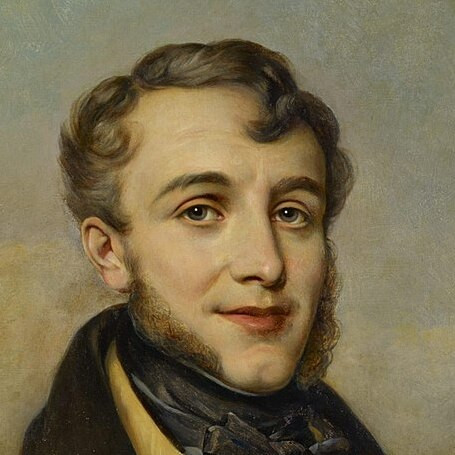
Friedrich Kalkbrenner
Did you know?
Chopin considered studying with Kalkbrenner's in 1831, but declined due to Kalkbrenner's three-year requirement.
Friedrich Wilhelm Michael Kalkbrenner, also known as Frédéric Kalkbrenner, was a German pianist, composer, and piano teacher. Born in 1784, he studied at the Conservatoire de Paris, eventually settling in the city until his death in 1849. Kalkbrenner's prolific career saw the composition of over 200 piano works, numerous concertos, and operas. In the late 1830s, Kalkbrenner's reputation was surpassed by rising stars like Chopin, Thalberg, and Liszt. Notably, Chopin dedicated his first piano concerto to Kalkbrenner, showcasing the latter's influence. Kalkbrenner's teaching legacy extended to notable pupils such as Marie Pleyel and Camille-Marie Stamaty, whose influence reached composers like Louis Moreau Gottschalk and Camille Saint-Saëns. As a pianist, teacher, and businessman, Kalkbrenner achieved considerable success in England, where he encountered an innovative piano teaching device called the chiroplast. The invention, co-opted by Kalkbrenner, contributed to his wealth and was instrumental in his establishment as a piano teacher. Kalkbrenner's career took him to Vienna, Berlin, and other European cities, showcasing his virtuosity and gaining widespread acclaim. Returning to Paris, Kalkbrenner partnered with Pleyel's piano factory and continued his musical and entrepreneurial pursuits. Despite facing competition from Liszt and Thalberg, Kalkbrenner maintained influence through a successful marriage to a titled French heiress. His impact endured through the 1830s, with Chopin briefly considering him as a mentor. Kalkbrenner's life concluded in 1849 when he succumbed to cholera in Enghien-les-Bains, leaving behind a legacy of compositions, influential teachings, and contributions to piano pedagogy.
