
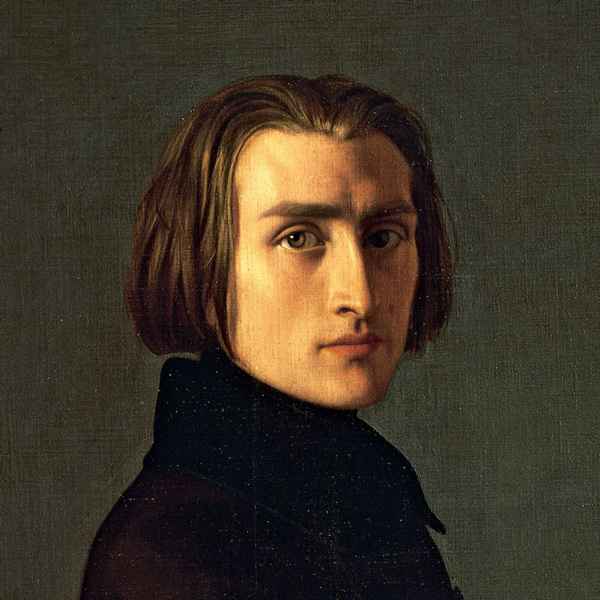
Franz Liszt
Did you know?
During Liszt's piano recitals in the mid-19th century, fans would tear down his clothes and fight over broken piano strings and locks of his hair. Europe had never seen anything like it, the phenomenon was named Lisztomania.
Franz Liszt was a prolific 19th-century Hungarian composer, virtuoso pianist, conductor, music teacher, arranger, organist, philanthropist, author, nationalist and a Franciscan tertiary during the Romantic era. Liszt gained renown in Europe during the early nineteenth century for his prodigious virtuosic skill as a pianist. He was a friend, musical promoter and benefactor to many composers of his time, including Frédéric Chopin, Richard Wagner, Hector Berlioz, Robert Schumann, Camille Saint-Saëns, Edvard Grieg, Ole Bull, Joachim Raff, Mikhail Glinka, and Alexander Borodin. As a composer, Liszt was one of the most prominent representatives of the New German School (Neudeutsche Schule). He left behind an extensive and diverse body of work in which he influenced his forward-looking contemporaries and anticipated many 20th-century ideas and trends. Some of his most notable musical contributions were the invention of the symphonic poem, developing the concept of thematic transformation as part of his experiments in musical form, and making radical departures in harmony.
