
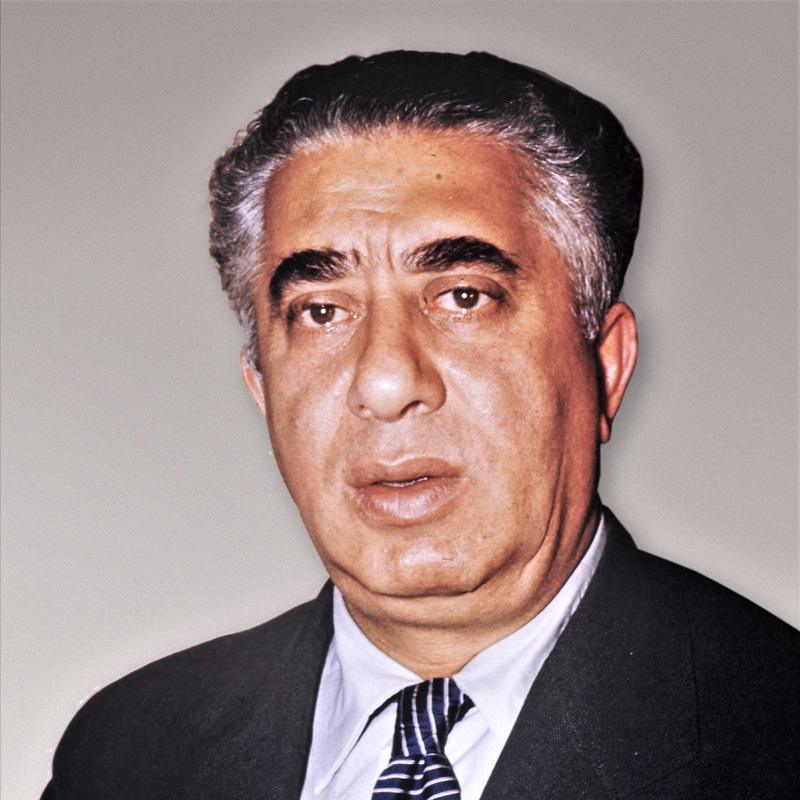
Aram Khachaturian
Did you know?
In 1998 Khachaturian's photo was featured in the 50-dram bill issued by the Central Bank of Armenia. It remained in use until 2004 when the bill was replaced by a coin.
Aram Ilyich Khachaturian was born on 6 June 1903 in Tbilisi, Georgia, into an Armenian family. In 1921 he moved to Moscow, soon entering the Gnessin Institute as a cellist and, in 1925, beginning composition studies, transferring in 1929 to the Moscow Conservatory and Myaskovsky’s class. From his earliest years he was fascinated by Armenian folk music, and ‘oriental’ sounds and melodies, graduating with a work in this style, the First Symphony (1934). Around the same time, he married the composer Nina Makarova, a fellow student from Myaskovsky’s class. In 1936, his substantial and popular Piano Concerto included Georgian as well as Armenian elements within a lushly romantic framework. 1940 saw two key works: incidental music for a production of Lermontov’s Masquerade, from which he produced a charming suite evoking the aristocratic world of early 19th-century St.Petersburg; and the brilliant and easily accessible Violin Concerto for David Oistrakh. During World War II Happiness was reworked as the patriotic ballet Gayaneh, with its famous ‘Sabre dance’. In 1943 came the epic Second Symphony, a vivid chronicle of the struggles of the war ending in a rousingly optimistic finale. The colorful Third Symphony that followed did not save him from brutal criticism at the 1948 Composers’ Congress for crimes of ‘formalism’. He responded with patriotic works including Ode in Memory of Lenin (1949). After Stalin’s death in 1953, Khachaturian was active as a public figure, being among the first to press for a relaxation of the harsh musical and artistic conditions in the Soviet Union. He was also writing, teaching, and traveling a great deal, and working on his massive 4-act ballet, Spartacus (1956), set in ancient Rome and with plenty of exotic elements and lashings of orchestral color in the music. In his last years, he wrote several more concertos, as well as chamber music. He died in Moscow on 1 May 1978.
