
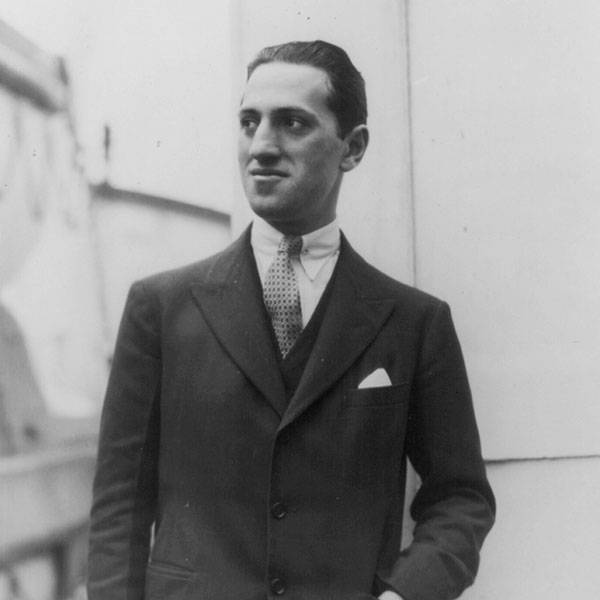
George Gershwin was born
Beginning of the composer’s lifetime.

Mamma
P. Tchaikovsky
Early intermediate
La cage de cristal
J. Ibert
Late intermediate
Prelude
T. Brown
Early intermediate
Prelude
J.S. Bach
Late intermediate
Humming Chorus
G. Puccini
Late intermediate

Sonatina
F. Mendelssohn
Late intermediate

Elegy
D. Shostakovich
Early intermediate
Allegretto
L.V. Beethoven
Advanced
Prelude
T. Brown
Late intermediate
Confidence
J.F. Burgmüller
Late intermediate

Sweet Lullaby
O.L. Fernández
Early intermediate
Entreating child
R. Schumann
Late intermediate
A free account includes access to this week’s Free Pick score.
Sign up freeBeginning of the composer’s lifetime.

Tosca is an opera in three acts by Giacomo Puccini to an Italian libretto by Luigi Illica and Giuseppe Giacosa. It premiered at the Teatro Costanzi in Rome on 14 January 1900. The work, based on Victorien Sardou's 1887 French-language dramatic play, La Tosca, is a melodramatic piece set in Rome in June 1800, with the Kingdom of Naples's control of Rome threatened by Napoleon's invasion of Italy. It contains depictions of torture, murder, and suicide, as well as some of Puccini's best-known lyrical arias.

The First Men in the Moon by the English author H. G. Wells is a science fiction novel about a journey to the Moon by two Englishmen who discover that a sophisticated extraterrestrial civilisation of insect-like creatures ("Selenites") inhabits the lunar interior. The first-person narrator Mr. Bedford, a businessman, recounts his adventure with an eccentric scientist (Mr. Cavor), who has invented a gravity-blocking substance (cavorite) that the pair then use to construct a spherical spacecraft to reach the Moon, hoping to find valuable minerals. The work was originally serialised in The Strand Magazine (UK) and The Cosmopolitan (USA) from November 1900 to June 1901 and was published in hardcover book form in 1901. Wells called it one of his "fantastic stories".

The Phantom of the Opera (French: Le Fantôme de l'Opéra, pronounced [lə fɑ̃tom də lɔpeʁa]) is a Gothic horror novel by French author Gaston Leroux. It was first published as a serial in Le Gaulois from 23 September 1909 to 8 January 1910, and was released in volume form in late March 1910 by Pierre Lafitte. The novel is partly inspired by historical events at the Paris Opera during the nineteenth century, and by an apocryphal tale concerning the use of a former ballet pupil's skeleton in an 1841 production of Carl Maria von Weber's Der Freischütz. It has been successfully adapted into various stage and film adaptations, most notable of which are the 1925 film depiction featuring Lon Chaney, and Andrew Lloyd Webber's 1986 musical.

The Treaty of Versailles was a peace treaty signed on 28 June 1919. As the most important treaty of World War I, it ended the state of war between Germany and most of the Allied Powers. It was signed in the Palace of Versailles, exactly five years after the assassination of Archduke Franz Ferdinand, the proximate cause of the war. The other Central Powers on the German side signed separate treaties. Although the armistice of 11 November 1918 ended the actual fighting, and agreed certain principles and conditions including the payment of reparations, it took six months of Allied negotiations at the Paris Peace Conference to conclude the peace treaty. Germany was not allowed to participate in the negotiations before signing the treaty.

The Turkish War of Independence (15 May 1919 – 24 July 1923) was a series of military campaigns and a revolution waged by the Turkish National Movement, after the Ottoman Empire was occupied and partitioned following its defeat in World War I. The conflict was between the Turkish Nationalists and the Allied and separatist forces over the application of Wilsonian principles, especially self-determination, in post-World War I Anatolia and eastern Thrace. The revolution concluded the collapse of the Ottoman Empire and the Eastern question, ending the Ottoman sultanate and the Ottoman caliphate, and established the Republic of Turkey. After leading the nationalists to victory, Mustafa Kemal Atatürk introduced revolutionary reforms as president of the new republic.
George Gershwin was 29 years old

The Empire of Japan's Kwantung Army invaded the Manchuria region of China on 18 September 1931, immediately following the Mukden incident, a false flag event staged by Japanese military personnel as a pretext to invade. At the war's end in February 1932, the Japanese established the puppet state of Manchukuo. The occupation lasted until mid-August 1945, towards the end of the Second World War, in the face of an onslaught by the Soviet Union and Mongolia during the Manchurian Strategic Offensive Operation.

The Second Italo-Ethiopian War, also referred to as the Second Italo-Abyssinian War, was a war of aggression waged by Italy against Ethiopia, which lasted from October 1935 to May 1936. In Ethiopia it is often referred to simply as the Italian Invasion (Amharic: ጣልያን ወረራ, romanized: Ṭalyan warära), and in Italy as the Ethiopian War (Italian: Guerra d'Etiopia). The war is regarded as the largest colonial campaign in history.
End of the composer’s lifetime.
Would you like to watch a synthesia of this piece?
Tap below to make your request.