PianoLIT icon
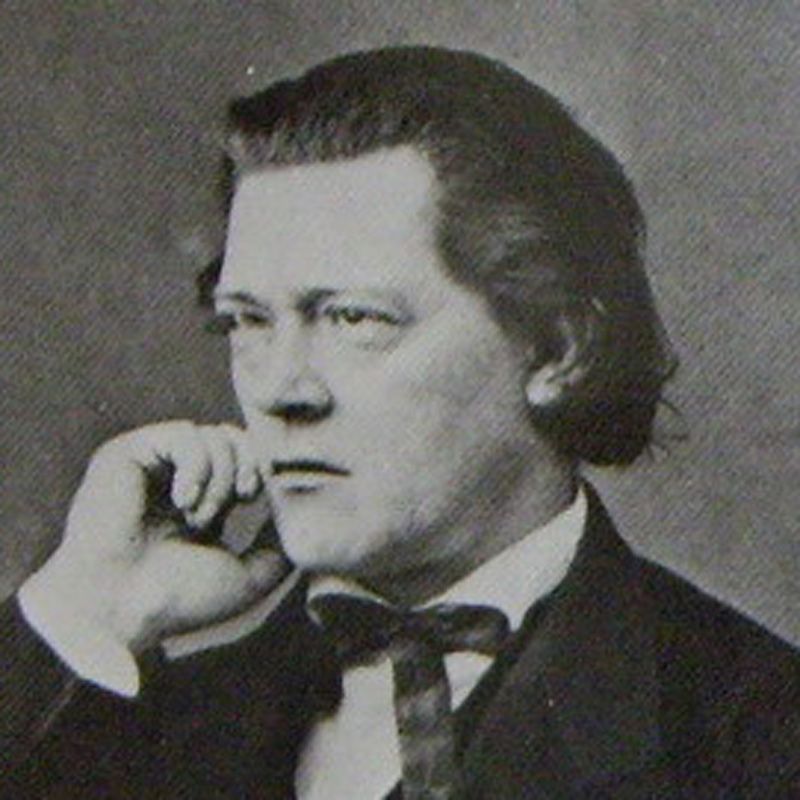
Portrait of Theodor Kirchner

Theodor Kirchner

Dec 10, 1823 - Sep 18, 1903

Germany

Theodor Kirchner was well liked by many important composers of the 19th century, but he struggled to keep a steady career. This difficulty came from his disorderly lifestyle, which included spending too much money and having a gambling addiction. Born in Neukirchen near Chemnitz, he was already skilled at playing the organ and piano by the time he was eight years old. Between 1838 and 1842, he studied piano with J. Knorr and organ and theory with K. F. Becker in Leipzig. Kirchner also learned from J. Schneider in Dresden and briefly attended the Leipzig Conservatory. In 1843, thanks to a recommendation from Mendelssohn, Kirchner became the organist in Winterthur, Switzerland. He stayed there for nearly twenty years but traveled often around Germany, becoming friends with Robert and Clara Schumann and Brahms. Clara Schumann liked him a lot but noted that he lacked stability, and they seem to have had a quiet affair during the early 1860s. Kirchner moved to Zurich in 1862 to lead subscription concerts, although this job only lasted three years. From 1862 to 1872, Kirchner taught at a music school in Zurich. He married in 1868, but the marriage did not work well. After working as an organist in Zurich starting in 1870, he became a court pianist in Meiningen in 1872. The following year, he was named director of the Conservatory in Würzburg and stayed until 1875. Between 1876 and 1883, he lived in Leipzig, then taught score reading in Dresden until 1890. Later, Brahms and other famous musicians raised money for him to pay off large debts. In 1890, Kirchner left his wife and family and moved to Hamburg, where a former student took care of him. He suffered two strokes that left him paralyzed in 1894 and was completely blind in the later part of his life. Kirchner passed away in Hamburg on September 18, 1903. He was respected by many well-known composers, including Mendelssohn, Robert Schumann, Brahms, Liszt, Wagner, Dvořák, and Grieg.

What was the world like

Theodor Kirchner was born

Beginning of the composer’s lifetime.

St Matthew Passion was published

The St Matthew Passion, BWV 244, is a Passion, a sacred oratorio written by Johann Sebastian Bach in 1727 for solo voices, double choir and double orchestra, with libretto in German by Picander. It sets the 26th and 27th...

Sources & credits Wikipedia · Wikidata (CC0); Wikipedia contributors (CC BY-SA 4.0). Text may be edited by PianoLIT.
Image · Johann Sebastian Bach IMSLP · Public domain
Franklin's lost expedition

Franklin's lost expedition was a failed British voyage of Arctic exploration led by Captain Sir John Franklin that departed England in 1845 aboard two ships, HMS Erebus and HMS Terror, and was assigned to traverse the la...

Sources & credits Wikipedia · Wikidata (CC0); Wikipedia contributors (CC BY-SA 4.0). Text may be edited by PianoLIT.
Image · Hans van der Maarel Previously unpublished. Provided by author to me for uploading on his behalf. · CC BY-SA 4.0
John James Audubon died

John James Audubon was a French-American artist, entrepreneur, naturalist, explorer, and ornithologist. His combined interests in painting and ornithology turned into a plan to make a complete pictorial record of all the...

Sources & credits Wikipedia · Wikidata (CC0); Wikipedia contributors (CC BY-SA 4.0). Text may be edited by PianoLIT.
Image · John Syme The White House Historical Association · Public domain
Les Misérables was published

Les Misérables is a French epic historical novel by Victor Hugo, first published on 31 March 1862, that is considered one of the greatest novels of the 19th century. Les Misérables has been popularized through numerous a...

Sources & credits Wikipedia · Wikidata (CC0); Wikipedia contributors (CC BY-SA 4.0). Text may be edited by PianoLIT.
Image · Gustave Brion Maison de Victor Hugo · Public domain
Through the Looking-Glass was published

Through the Looking-Glass, and What Alice Found There is a novel published in December 1871 by Lewis Carroll, the pen name of Charles Lutwidge Dodgson, a mathematics lecturer at Christ Church, Oxford. It is the sequel to...

Sources & credits Wikipedia · Wikidata (CC0); Wikipedia contributors (CC BY-SA 4.0). Text may be edited by PianoLIT.
Image · Tim riley (talk · contribs) https://en.wikipedia.org/wiki/File:Alice-entering-looking-glass-house-vertical-alignment.png · Public domain
Fyodor Dostoyevsky died

Fyodor Mikhailovich Dostoevsky was a Russian philosopher, novelist, short-story writer, essayist, and journalist. He is regarded as one of the greatest novelists in both Russian and world literature, and many of his work...

Sources & credits Wikipedia · Wikidata (CC0); Wikipedia contributors (CC BY-SA 4.0). Text may be edited by PianoLIT.
Image · Vasily Perov Google Arts & Culture — kgHBFHS7SpcayQ · Public domain
The Picture of Dorian Gray was published

The Picture of Dorian Gray is an 1890 philosophical fiction and Gothic horror novel by Irish author Oscar Wilde. A shorter novella-length version was published in the July 1890 issue of the American periodical Lippincott...

Sources & credits Wikipedia · Wikidata (CC0); Wikipedia contributors (CC BY-SA 4.0). Text may be edited by PianoLIT.
Image · Unknown authorUnknown author From part one of The Elmer Holmes Bobst Library's online exhibition: Reading Wilde, "Querying Spaces: An Exhibition Commemorating the 100th Anniversary of the Trials of Oscar Wilde"; plus direct link to image · Public domain
Giuseppe Verdi died

Giuseppe Fortunino Francesco Verdi was an Italian composer best known for his operas. He was born near Busseto, a small town in the modern province of Parma, to a family of moderate means, receiving a musical education w...

Sources & credits Wikipedia · Wikidata (CC0); Wikipedia contributors (CC BY-SA 4.0). Text may be edited by PianoLIT.
Image · Ferdinand Mulnier https://www.artic.edu/artworks/86950/giuseppe-verdi-italian-composer-1813-1901 · Public domain
Theodor Kirchner died

End of the composer’s lifetime.