
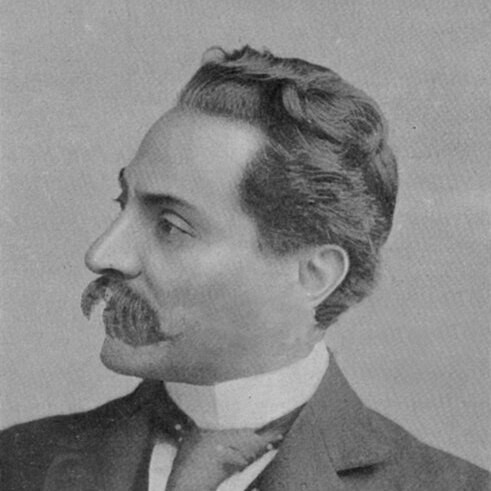
Giuseppe Martucci
Did you know?
Arturo Toscanini named his daughter Wally after a song from Martucci’s La canzone dei ricordi.
Giuseppe Martucci was a key figure in Italian music during the late 19th and early 20th centuries, often called "the Italian Brahms" for his dedication to instrumental music at a time when Italian composers were primarily focused on opera. A child prodigy, he trained at the Naples Conservatory, later becoming a highly respected teacher and pianist. As a conductor, Martucci played a crucial role in introducing the works of Wagner to Italy, conducting the country's first performance of Tristan und Isolde in 1888. He also promoted symphonic music by composers like Brahms and Stanford, helping to cultivate a greater appreciation for orchestral and chamber music in Italy. As a composer, Martucci stood apart from his Italian contemporaries by focusing entirely on absolute music—symphonies, piano concertos, chamber works, and songs—rather than opera. His most significant compositions include two symphonies and two piano concertos, as well as the Canzone dei ricordi, a song cycle that showcases his lyrical, Romantic style. His Second Symphony, completed in 1904, was praised as marking the rebirth of Italian instrumental music, influencing later composers like Respighi. Martucci's works blend Germanic structure with Italian lyricism, making them unique contributions to the orchestral repertoire. Despite being overshadowed by opera composers of his time, Martucci’s legacy endured through the advocacy of Arturo Toscanini, who frequently performed his music. In recent decades, there has been a renewed interest in his works, with recordings and performances led by conductors such as Riccardo Muti. His contributions laid the groundwork for the resurgence of instrumental music in Italy, proving that Italian composition could flourish beyond the opera house.
