


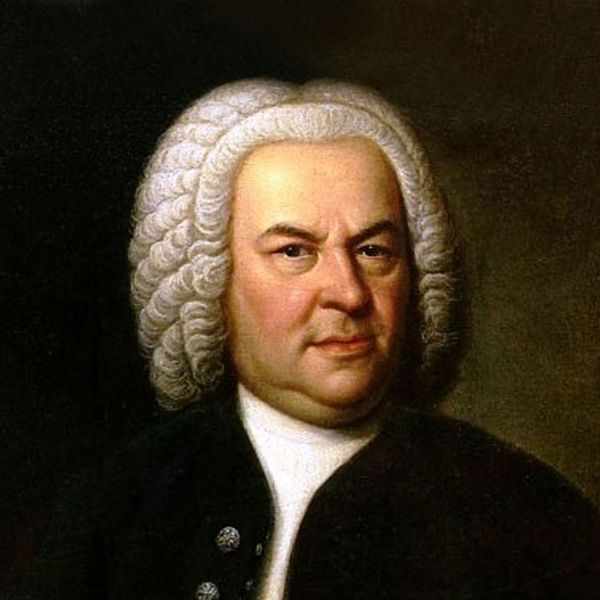
Johann Sebastian Bach was born
Beginning of the composer’s lifetime.


Prelude
J.S. Bach
Early intermediate

Keyboard sonata
D. Scarlatti
Late beginner
Prelude
J.S. Bach
Late beginner
Prelude
J.S. Bach
Early intermediate
No matching pieces found

The Little Night Thing
D. Waxman
Early beginner

Baby Falls Asleep
H. Chrétien
Early beginner

Andantino con grazia
C. Czerny
Early beginner

Sprite's Dance
U. Kay
Late beginner
A free account includes access to this week’s Free Pick score.
Sign up freeBeginning of the composer’s lifetime.

The Russo-Turkish War of 1686–1700 was part of the joint European effort to confront the Ottoman Empire. The larger European conflict was known as the Great Turkish War.

Os Lusíadas (Portuguese pronunciation: [uʒ luˈzi.ɐðɐʃ]), usually translated as The Lusiads, is a Portuguese epic poem written by Luís Vaz de Camões (c. 1524/5 – 1580) and first published in 1572. It is widely regarded as the most important work of Portuguese-language literature and is frequently compared to Virgil's Aeneid (1st c. BC). The work celebrates the discovery of a sea route to India by the Portuguese explorer Vasco da Gama (1469–1524). The ten cantos of the poem are in ottava rima and total 1,102 stanzas.

Domenico Alberti (c. 1710 – 14 October 1746 (according to other sources: 1740)) was an Italian singer, harpsichordist, and composer.
Johann Sebastian Bach was 32 years old

Robinson Crusoe (, KROO-soh, zoh) is an English adventure novel by Daniel Defoe, first published on 25 April 1719. It is often credited as marking the beginning of realistic fiction as a literary genre in the English language, and has been described as the first novel in English – although this label is disputed.

Johann Sebastian Bach's Magnificat, BWV 243, is a musical setting of the biblical canticle Magnificat. It is scored for five vocal parts (two sopranos, alto, tenor and bass), and a Baroque orchestra including trumpets and timpani. It is the first major liturgical composition on a Latin text by Bach.

Messiah (HWV 56) is an English-language oratorio composed in 1741 by George Frideric Handel. The text was compiled from the King James Bible and the Coverdale Psalter by Charles Jennens. It was first performed in Dublin on 13 April 1742 and received its London premiere a year later. After an initially modest public reception, the oratorio gained in popularity, eventually becoming one of the best-known and most frequently performed choral works in Western music.

Johann Sebastian Bach (31 March [O.S. 21 March] 1685 – 28 July 1750) was a German composer and musician of the late Baroque period. He is known for his prolific output across a variety of instruments and forms, including the orchestral Brandenburg Concertos; solo instrumental works such as the Cello Suites and Sonatas and Partitas for Solo Violin; keyboard works such as the Goldberg Variations and The Well-Tempered Clavier; organ works such as the Schübler Chorales and the Toccata and Fugue in D minor; and choral works such as the St. Matthew Passion and the Mass in B minor. He is known for his mastery of counterpoint, as heard in The Musical Offering and The Art of Fugue. Felix Mendelssohn precipitated the Bach Revival with a performance of the St. Matthew Passion in 1829. Ever since, Bach has been acclaimed as one of the greatest composers in the history of Western music.
End of the composer’s lifetime.
Would you like to watch a synthesia of this piece?
Tap below to make your request.